Blog
Six Questions Utilities Are Asking about Commercial Building Demand Flexibility
August 06, 2026
Share


Key Takeaways:
- Demand flexibility is the ability to shed, shift, or shape electrical loads in response to grid needs, energy prices, or other utility requests.
- “Missing middle” commercial buildings are too complex for simple utility programs and too small for custom programs reserved for large energy users. Schools, offices, municipal facilities, healthcare facilities, and retail properties are among the buildings with significant controllable load.
- Automated controls enable reliable participation while protecting occupant comfort and reducing the burden on facility teams.
- Connecting energy efficiency with demand flexibility provides year-round value for utilities and buildings.
- Utilities could bring new virtual power plant (VPP) capacity online in months rather than years by making existing commercial building loads dispatchable.
- Edo’s Demand Flex offering uses building data and automation to find flexible loads and adjust them based on grid needs, whether that means reducing demand during peak events or making smaller daily changes that can lower energy costs.
Interconnection delays and rising energy costs are making it harder for utilities to build traditional infrastructure. This creates urgency for cost-effective, predictable capacity with quick deployment. Mid-sized commercial buildings offer a valuable source of capacity that has often been overlooked. These “missing middle” buildings are too complex for one-size-fits-all smart thermostat or behavioral programs but are not typically served by custom programs designed for larger energy users. However, with the right technology and program structure, they can provide measurable demand flexibility while improving building performance.
Wondering whether commercial building demand flexibility could benefit your utility? Here are answers to six common questions to help you understand the opportunity and what it takes to incorporate these buildings into a virtual power plant (VPP).
1. What is demand flexibility, and how is it different from traditional demand response?
Utility demand response programs typically call on customers to curtail electricity use during peak periods or grid emergencies. Participation may rely on building staff manually shutting down equipment or following a predetermined curtailment plan.
Demand flexibility takes a more dynamic, ongoing approach. It is the ability to shed, shift, or shape electrical loads in response to grid needs, energy prices, or utility requests. Building data, forecasting, and automated controls can help identify and adjust those flexible loads, whether by reducing demand during an event, shifting it to another time, or making smaller ongoing changes.
Demand response remains an important use case within demand flexibility, but it is no longer the only interaction between a building and the grid. A connected building can provide flexibility at different times while continuously improving how it uses energy.
2. Why are “missing middle” commercial buildings an important grid resource?
Missing middle commercial buildings represent a significant source of controllable electrical load that utilities have historically struggled to engage. When connected and aggregated, these buildings can provide utilities with:
- Untapped capacity: Schools, offices, municipal facilities, community centers, outpatient healthcare facilities, and retail properties contain substantial controllable load.
- Portfolio diversity: Different operating schedules and load profiles create flexibility across times, seasons, and locations.
- Faster deployment: Existing building loads can provide capacity in months rather than waiting years for infrastructure deployment.
- Reliable response: Automation makes building response more consistent, reducing the need for manual action by facility staff and helping prevent opt-outs.
3. What types of commercial buildings and loads are good candidates?
Strong candidates are not defined by building type alone. Utilities should consider the building’s systems, available loads, operating schedule, and primary use to determine measurable flexibility.
| Characteristic | What utilities should look for |
| Existing building automation | Systems that can be monitored and controlled without a major equipment overhaul |
| Controllable electrical loads | HVAC, lighting, EV charging, batteries, or other loads that can be adjusted without disrupting essential operations |
| Useful load timing | Electricity use that overlaps with system peaks or targeted local grid constraints |
| Available building and meter data | Sufficient data to forecast flexibility and measure performance |
| Engaged facility team | Operators interested in improving performance and participating in utility programs |
| Portfolio value | A load profile, location, or operating schedule that complements other enrolled buildings |
Operating schedules matter as much as building size or equipment. A school that has already reduced its summer evening load may offer little flexibility during an evening event but provide more capacity on a cold weekday morning. A building with extended hours or varying occupancy may contribute at other times.
Not every building will be an ideal resource for every event. However, buildings with different load profiles can collectively provide valuable flexibility as part of a diverse portfolio.
4. How can commercial buildings provide reliable flexibility without disrupting occupants?
Reliable flexibility requires automated participation, distributed action, and ongoing visibility into building performance. Edo communicates with existing building automation systems to monitor equipment performance and identify available flexibility. Building data can be combined with utility meter data to forecast how much load a site can provide at a particular time. Adjustment strategies are then configured around the building’s operating requirements and are automated within the building’s approved comfort parameters.
Load adjustments are also distributed across multiple connected loads within each enrolled building. This means that each change can be more subtle, and no single piece of equipment is bearing the burden of participation. This also allows adjustments to be made in stages to avoid creating a sudden rebound peak. Buildings retain control and can override actions or opt out when operations require it.
Performance is measured before, during, and after events. Continued monitoring also allows control strategies to improve over time as the platform learns what each building can reliably provide without generating comfort complaints or operational problems.
5. How can energy efficiency and demand flexibility work together?
Energy efficiency and demand flexibility are often managed through separate utility programs, but connecting them can provide greater value to the grid and the customer.
Once a building is connected with an Edo Gateway, ongoing data can reveal equipment running outside occupied hours, incorrect schedules, control issues, or systems that are not operating as intended. Addressing these problems can reduce energy waste and lower costs throughout the year. The same Edo Gateway can then automate load adjustments when the grid needs additional flexibility.
In some cases, improving efficiency may reduce the load available during a typical demand response window. Because energy efficiency and demand response programs are often managed through separate programs, that permanent load reduction can make the building appear to provide less grid value. However, the building is still using less daily energy while remaining available to provide flexibility to the grid when needed. Integrating energy efficiency and demand flexibility programs allows utilities to recognize both the building’s ongoing energy savings and its continued ability to offer flexibility.
This year-round operational value can also strengthen customer participation. Building operators gain useful insights and better performance rather than receiving value only when a demand response event occurs.
6. What does it take to aggregate and scale commercial buildings into a VPP?
Scaling begins with clear utility objectives. A program designed to address a statewide system peak may require a different portfolio than one targeting a constrained substation or a specific time of day. Those needs should guide customer recruitment, program rules, dispatch strategies, and measurement.
Utilities can build on existing relationships by involving energy efficiency teams and customer account managers who understand local buildings. Once customers enroll, Edo connects with their existing systems, maps available data and controls, and automates participation within approved parameters.
Edo does not replace a building energy management system or a utility’s distributed energy resource management system. Demand Flex acts as a software layer between them, optimizing individual buildings and aggregating their flexible capacity at the portfolio level. The platform can receive grid signals, coordinate load adjustments based on availability and location, and report performance through established measurement and verification approaches.
Ongoing monitoring allows utilities to refine performance as participation grows, turning previously overlooked commercial load into a more predictable, dispatchable grid resource.
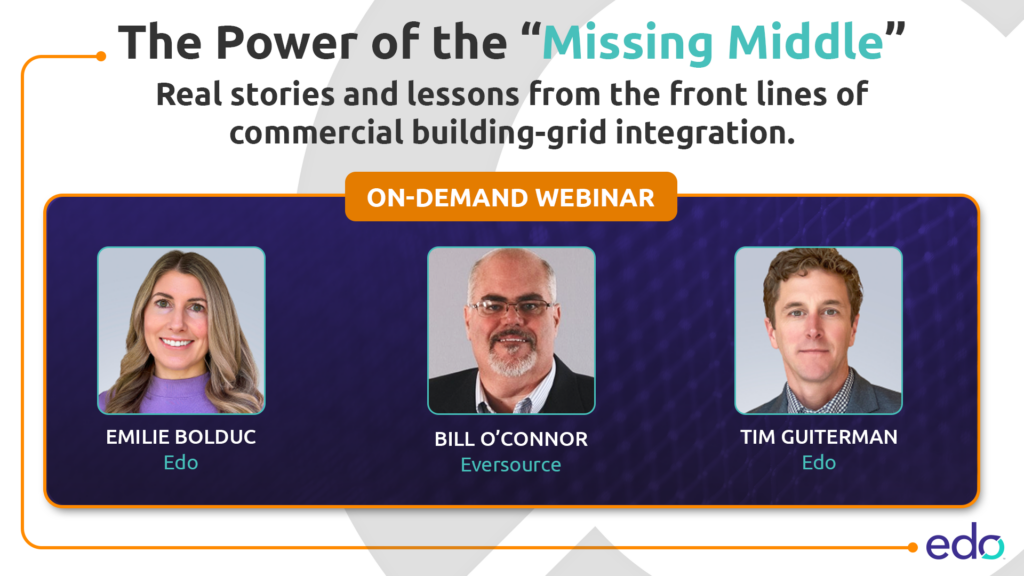
Momentum is building around demand-side energy resources. For example, 35 states and the District of Columbia advanced VPP and distributed energy resource aggregation policies in 2025, while utilities continued seeking ways to bring more customer resources into the grid mix. Missing middle commercial buildings offer a significant opportunity to contribute to that momentum with their own flexible, dispatchable capacity. Watch Edo’s on-demand webinar, The Power of the “Missing Middle,” to see a real-world example of how this approach can work in practice.